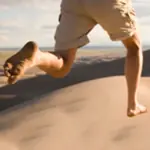
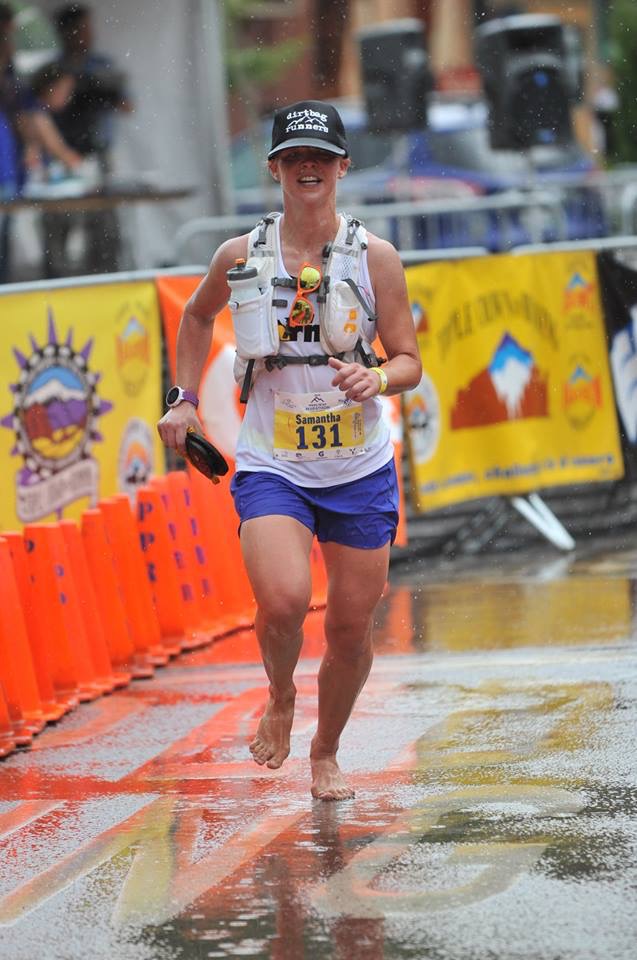
Truth be told, I’m getting excited for sandal
season to start again.I am solidifying
my race calendar and I am planning to cap the year with the Leadville 100-mile
trail run and maybe even another Spartan World Championship.As each of us look to our summer and fall
running seasons I wanted to share one of the best and most simple form fixes you
can implement now to give you a more successful season.
One of the most common mistake runners make in their form is to
over-stride.Over-striding can be
defined as any form of landing that causes a braking force.One of the easiest cues to help remedy this
situation is to simply “bend your knees more.”In theory, when we are running we are using our legs as giant
springs.If our knees are not flexed
enough during running gait we are more likely to land with the foot too forward
of our center of mass.This forward foot
landing creates a brake and
diminishes our forward momentum.This
braking effect leads to higher impact forces and reduces our running economy.
Need a good example of the difference bending your knees can make? Compare yourself running up a steep hill
versus down the same hill.Because it
takes excessive effort to over-striding while running uphill, most people don’t
do it.They instead bend their knees
more and take shorter steps.On the
other hand, over-striding is very common while running downhill.Film yourself running downhill, then repeat
with your knees bent deeper.You should
see a smoother decent with your knees bent more (i.e. less bobbing up and down).Combine this with an increased cadence and the results should be less
achy hips and knees.
In addition to bending the knees and allowing your leg springs to
work, I also like to focus on relaxing my calf muscles and the tops of my
feet.Bending your knees more should
help to relax your calves naturally but if you’re used to holding excess
tension in your calves and feet, you might want to cue yourself to relax
further.Many runners who over-stride will
also demonstrate increased vertical oscillation (i.e. bobbing up and down).Following the aforementioned cues can improve your efficiency and likely
allow you to train more miles and a faster pace due to less impact forces.
Bending the knees helps you land with your foot closer to your center of mass.
Filming your gait can be your best tool because sometimes what we
think we are doing is not what we are actually doing.I often use film for my runners so that they
can compare how different cues change their gait.When we see improved efficiency and when the
runner feels smoother and more comfortable, we know that we’ve found the right
cue.I have found over the years that
“bend the knees more” has been one of the best cues to reduce impact forces and
smooth out gait.This is especially true
for downhill running when runners are most likely to over-stride.Experimentation is the foundation of learning
so it’s up to you to give these cues a try and see how your body responds.
Best wishes for a happy and healthy running season!
My apologies for the lack of NPR posts as of late. I joke with my friends and family that I have about 5 jobs (things I get paid to do), and like most of you, a dozen or more regular roles I play. Still I really am quite passionate about sharing good information (and stories) when I can get around to it and today is one of those glorious days. As you all know, I have been obsessed with feet and their function since I made my own transition to barefoot running (and more minimal shoes/sandals). In my own transition, I was quite horrified to realize just how damaging the myths of footwear have been to both myself and most in our modern society. This along with running form and training methodology are perhaps my favorite topics of discussion (at least in the rehab and performance world). I also love everything related to the outdoors, coffee, and building things. So without further adieu, I wanted to share this success story from a fireman who lives in the Nashville area and reached out to me last summer through our mutual friend. I'll start from the beginning when "Q" contacted us through our website...
Hello,
I am a paramedic and a firefighter and I watched some of your YouTube videos that a mutual friend (JP) showed me for feet exercises. I looked up your website from the video and saw that y'all offer a discount for first responders. I just wanted to say thank you and let you know it is much appreciated. If I didn't live in the Nashville area I would probably be a client, but I just wanted to say thanks for the information and offering us a discount!
I replied with a few additional resources. "Q"s personal story is more in-depth on his next email response.
JP actually showed me some of your YouTube videos and I found your blog after that. I developed plantar fasciitis over two years ago. It was mostly from jogging hours on end barefooted with my daughter that had colic (it was the only way to get her to not cry) and heavy turnout gear for work. I went to the podiatrist and she said I had "really flat feet" and said I pretty much just had to live with it, wear orthotics, and never go bearfooted again. I have pretty much completely quit running and changed my whole PT (training not therapy) regime to cope with it. While the plantar fasciitis has gotten better, my feet over all are weaker and ache more than they used to. I started reading more stuff and came to the crazy hypothesis that through PT I could strengthen my feet and even maybe not be flat footed anymore. I was asking JP's input on my theory and that's when she pointed me in your direction. For the first time in a couple years I feel like there is hope and I won't be hobbled and decrepit! I know that might sound a little melodramatic, but as much time and money as I have wasted trying to find the right insoles, shoes, orthotics, and so on with no real solution, maybe it's not. I am just amazed that someone can have a doctorate in feet and be so terrible at feet (in reference to the podiatrist I went to, and have had friends/coworkers with similar experiences). That's why I wanted to email y'all and say thanks for putting so much good and free information out there! I started doing exercises almost a week ago and already have noticed an improvement. Tomorrow when I am on shift, I will start to implement the stuff from your blog.
I hadn't heard from "Q" since last July until yesterday when I received this email.
Hey Sam, it’s been a while since I emailed you. I am JP's friend that is a firefighter that had flat feet. I just got done with my annual work physical and my doctor (former Brigadier General for the Army) called me a “dumb shit.” I was honored! I figure after a full military career and 49 years as a MD, doing something to illicit being a “dumb shit” from a Church of Christ, retired General was quite a feat!
We got to the interview portion of the physical and he asked about my flat feet. I wore shoes today to avoid having to explain myself, but it didn’t work. I told him I had been working on them. He asked what that meant. I told him I have been doing a lot of physical therapy exercises and running barefoot and that I have got to where I can run a mile with no problems. It was at this point he sat straight up in his chair and called me a dumb shit. I took my shoes off and showed him my feet. He starred at them, stuck a finger under my arch and said, “You have arches! I guess we will take that off your record. So how does one go about rebuilding their arches?” I demonstrated several exercises and explained my position on feet have been weakened by shoes and are not allowed to function as designed. He didn’t buy it and I did not convert him, but he could not argue with my arches.
I showed him a YouTube video showing the natural versus shod running forms and the differences of impacts on pressure plates and he said I was still a dumb shit but he did hear me out. I figured you would get a kick out of it, but also hope it’s encouraging! Thanks for putting your blog and videos up, because I was feeling kind of hopeless and doomed to a life of hobbeling around and not running and playing with my kids before I started the transition. Thanks for the help and I hope you enjoyed the story!!!
Thanks! Q PS I have gotten up to running 1 mile barefoot in the grass with no problems!!!
Wait what?! You strengthened your arches???
Right medial arch before strengthening
Right medial arch after strengthening
Left arch before strengthening
Left arch after strengthening
The email from "Q" highlights a great story of self-discovery, discipline, tenacity, learning, and growth. I believed many of those same myths prior to my experimentation and once you're on the other side you begin to realize how many beliefs turn out to be ridiculous and very limiting. I've stated many times that permanently casting/bracing the feet makes no more sense than doing the same to any other body part. I previously highlighted Barefoot Matt's story which is quite similar. Having bunions and imperfect feet myself, I resist the idea that one's foot has to look like the ideal in order to go barefoot. What we need are strong and flexible feet, good reflexes, and muscles/tendons that have undergone smart training. No one preaches that everyone with scoliosis should avoid loading the spine for the rest of their lives because it's not perfectly balanced. I hope you raise an eyebrow when someone suggests that permanently limiting the use of a body part is the answer to your injury or mal-alignment issue. As a therapist I can only say, welcome to the mal-alignment club...now let's learn to move better.
Wednesday, July 5, 2017
Treating Injuries:
Are Rest, Ice, Compression,
and Elevation Appropriate?
“Coaches
have used my “RICE” guideline for decades, but now it appears that both Ice and
complete Rest may delay healing, instead of helping.”
– Gabe
Mirkin, MD, March 2014
Dr. Mirkin first used the term Rest, Ice, Compression and
Elevation (RICE) in 1978.In the years
that followed RICE became recognized as the standard of care for acute injuries
(especially for the ankle).RICE was actually later modified to Range of
motion, Ice, Compression, and Elevation to reflect the need for movement after
an injury.Today, the original developer
of the RICE protocol, Dr. Mirkin, now believes that both ice and rest may actually
delay healing.Inflammation is the
body’s natural response to injury and brings in important healing factors.By applying ice and compression early, we may
inhibit swelling but this also inhibits the body bringing in important cells to
begin the healing process.Attempting to
inhibit swelling early on may actually delay healing.Additionally, Dr. Mirkin has found that “Anything
that reduces your immune response will also delay muscle healing, such as
cortisone-type drugs, pain-relieving medicines like NSAIDS, immune-suppressants,
and applying cold packs or ice.”
So what is the
answer?
Reducing an athlete’s symptoms requires load
management.Isometric (holding against
resistance while not moving) contractions have been shown to be analgesic and
pain reducing.It is important to factor
in stage of tendinopathy and treat it as part of a well-rounded rehabilitation
program involving kinetic chain exercises, education in proper landing
technique, and management of load and return to sports.Additionally, children heal faster and
require little external help except management of pain and loading for short
periods of time.
Recommendation
Avoid ice, NSAIDs, or other corticosteroids early on.A short bout of 3-5 minutes of ice may be
appropriate for pain management to allow the athlete to movement and begin load
management as soon as possible.
Rudavsky A, Cook J. Physiotherapy
management of patellar tendinopathy (jumper’s knee). Journal of Physiotherapy. 2014.
60: 122–129.
Wanted to share this article on barefoot living and using minimal shoes from another great experimenter. This is one of those life lessons I keep learning over and over again. Be flexible, adaptable, open, willing to try new things and experience new paradigms. Ultimately we have to be our own experimenters, despite whatever the latest study might suggest is correct, the answer is what works best for us.
A common myth we have all heard floating around at one time or
another is that running will "ruin your knees."This is even stated by some well-meaning
medical practitioners despite the lack of scientific evidence.In fact, studies suggest that if anything,
runners are less likely to develop debilitating hip or knee osteoarthritis when
compared to a more sedentary population (ref 1 & 2).
That said, many runners do suffer with knee pain at some point in
their running careers.This month I hope
to direct your attention to a few common causes of knee pain and broadly
discuss their remedies.Let me preface
the rest of this article by saying for most knee pain caused by activity, the
official diagnosis isn’t particularly helpful.It’s the medical version of Juliet’s monologue on the balcony, “what’s
in a name?” she says!Whether you have
tendonitis, tendonosis, a partial tear of something, iliotibial band syndrome,
or you ate too much cake last night…the key in recovering is finding the
dysfunction.
Problem #1 - Hip and/or ankle stiffness
The ball and socket joint of our hips provide our lower
extremities with a great deal of motion and adaptability.Likewise, our feet and ankles are paramount
in adapting to our running surface.If
either of these areas lack proper range of motion, it's not uncommon for this
imbalance to manifest itself as knee pain.Because the hips and/or foot/ankle complex is not moving correctly, the
knee will take excess stress.Your
practitioner should always check your hip, ankle, and foot for restrictions if
you present to them with knee pain.Once
you understand the problem, the remedy is quite intuitive, improve range of
motion and practice basic exercises to ensure the muscles of the hip, ankle,
and foot are working properly.
Problem #2 - A lack of pelvic and core control
This problem is a bit more insidious and often more difficult to
self-test.Essentially, many of us have
muscle imbalances involving our spines and pelvis.Some of these imbalances may occur because we
sit too much or we over-train one movement or activity.Most adults do not move in novel ways unless
they are actively engaged in a movement practice or have a job that requires
many different types of activities (i.e. When was the last time you did a cart-wheel?).
Ultimately, the muscles throughout our trunk (core) must
coordinate with the muscles in our hips to provide a stable pelvis when
running.If we are not coordinating
things correctly we may find that we have chronic back, hip, knee, or even ankle/foot
pain.The coordination process is quite
complicated but thankfully the remedy is usually much more simple.In the same way that one learns to throw a
baseball or play the violin, we can break down the basic movements of the spine
and pelvis, testing each one until we find a lack of integrity.
On slow motion analysis, a lack of pelvic or core control can
manifest itself in a loss of alignment in the spine, pelvis, knees, and the
ankle/foot.It is usually most evident
in the mid-stance phase, when all of the body weight is rested on a single
leg.It is at this point we usually see
a break down of control.
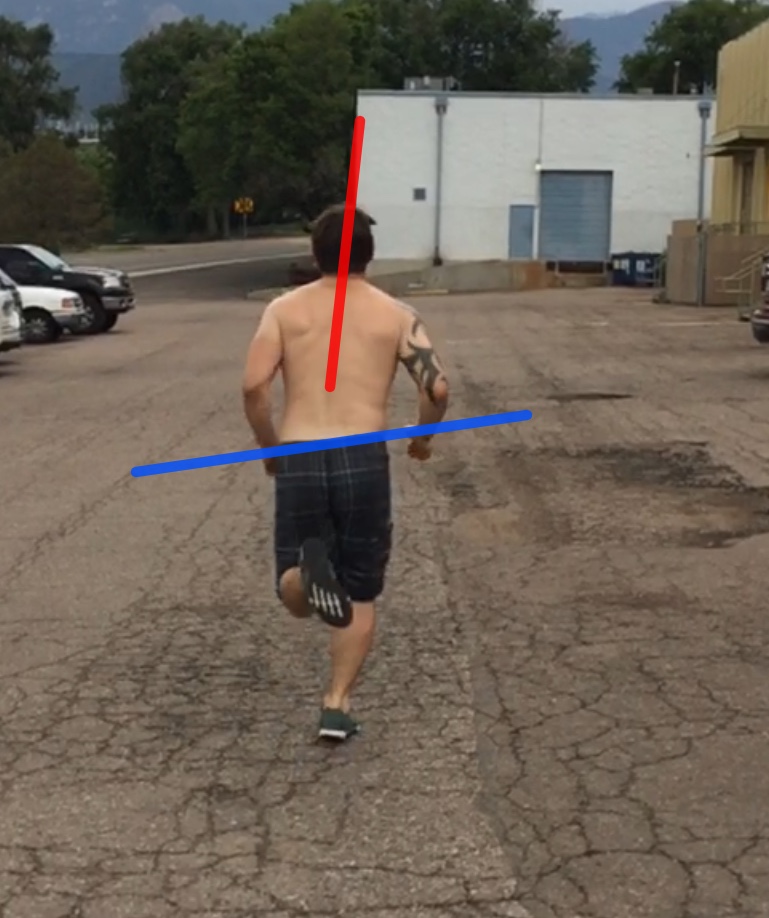
If my pelvis dramatically loses alignment (drops in mid-stance), my entire lower extremity and spine will have to compensate. Here we see a mostly level pelvis which allows the knee to stay aligned between the hip and foot.
On the other hand, a hip drop will cause compensation somewhere else in the body. This gentleman is leaning his trunk to maintain balance and may also be increasing injury in the lower extremity. Notice his left foot (behind him) is crossing towards the right leg which further identifies the hip drop.
Problem #3 - A lack of foot control
In our world of overly-cushioned shoes and high-priced orthotics,
most runners today lack proper foot function.It is a self-fulfilling prophecy to say that people need motion control
shoes because they have never learned to control their own foot motion.On slow-motion running gait analysis, the
same pitfalls seen with poor pelvic control can be caused by a lack of foot
control.In fact, unless a practitioner
tests both areas, they won't know which is causing the problem.Often it is best to treat control and
coordination issues globally because we know that everything has to work
together to produce a healthy running gait.
Problem #4 - Over-striding or slow cadence
I have discussed this topic in the past but suffice to say
over-striding or running with a slow cadence (<160 steps-per-minute) is
highly associated with more impact force through the lower extremity.Greater impact forces are associated with
more lower extremity injuries to include knee pain.Strength training and plyometric drills can
help to improve force output, meaning, it is easier for us to run and maintain
a healthier, more efficient cadence.Poor
force output resembles the ultra-shuffle while a high-force output can be seen
in sprinters and excellent long-distance runners (Eliud Kipchoge anyone?).
Over-striding is equivalent to "braking" when running. Ideally our feet will land closer to our center of mass.
Problem #5 – Doing too much too soon
We are all aware of this rule in exercise but I’m mentioning it
anyway.Because you could be doing
everything else right but you’re doing more exercise than your body can adapt
to within a given time frame.Remember
that exercise is a stress to the body and can depress our immune systems and
cause injury when taken far beyond our current abilities.The key to avoid this pitfall is to ask
yourself before your workout, can I actually recover from this workout?If you’re not getting enough sleep, mobility
work, time spent relaxing, or good nutrition, you’re basically a ticking
time-bomb for something breaking down.
Whether you visit me in the office or you already have a trusted
practitioner, the path to healthy knees should include some sort of learning on
your part.I watch runners flock to
quick fixes because they do not understand their problem.But trust me, no human was born with a Hoka
or orthotic deficiency.If you're
anything like the modern human, you probably need a little more balance in your
life.Finding out the true cause should
be your aim.Whatever you do, don't give
up on running.
Ref 1:
Effects of Running and Walking on Osteoarthritis and Hip Replacement Risk. Med Sci Sports Exerc. 2013 Jul; 45(7): 1292–1297.
Ref 2: Long
Distance Running and Knee Osteoarthritis A Prospective Study. Am J Prev Med.
2008 Aug; 35(2): 133–138.
I have struggled with the numbers game for some time but lately
I realize that numbers (amount) do not mean nearly as much as purpose
(quality).
It sad when I see my friends, people I know, and so called
experts post how many days they go to the gym, focus on how many reps they do, and focus on how
many workouts they do. It's even sadder when they equate the high number
of things they do as the main reason for their success. It is not the
high number of things they do, but the quality of what they do. If you work
out hard 6 days a week, do you think that all the workouts are
quality? It's likely a few of those workouts are good but the
others are "just get it down" work outs (I like to call them junk work out or for running junk miles). The just get it done
workouts can actually harm you by decreasing neuromuscular improvement or
increasing your risk for injury.
If you work out hard all the time or at a high intensity, your body will
eventually lose efficiency.
You are completely taxing your system and not
allowing for proper recovery. Additionally, you should have a goal with
each workout that does not include "just make it through it."
Good form, improvement in skill, improvement in strength, and/or endurance
should be the goal (pick a primary and secondary goal for each workout).
Another goal should be to not get injured or feel "beat down." You
can have hard workouts that tax you but they should be to test your improvement
not the norm.
Injury occurs from both mental and physical fatigue.
Injury occurs
when you one or more areas are overloaded to the point that they body cannot
continue to adapt enough. So, if you are sore all the time or working to
maximum do you think you fatigue mentally and physically? Do you think
you will become stiff and not able to control the movements properly
leading to excessive overload? So, why not try to stay mentally focused
and physically able? Maybe, program in some warm-up and recovery (do not
rely on your coach or instructor to do this for you)?
Instead of focusing on hitting the gym, trails, pavement, etc. 5-6
days week, maybe focus on 3 good workout and 2-3 days of mobility and skill
building.
Instead of thinking always about the number of sets and
reps, think about good quality reps and sets. This all applies to running
as well. Instead of always focused on miles or time, focus and quality
running that improves your abilities. Running 100 miles a week without a
purpose or goal besides getting the miles is only going to get you 100 miles
with some improvements. It will most likely get you hurt and frustrated
as well. Better every day should be your focus not more
every day (more ≠ better, better =
better).
If you are interested in quality of movement and exercise, Natural
Performance Rehab offers group classes or individual sessions to help you understand
and improve your quality and become better every day.
Now that I have bestowed my opinion on the webernets regarding what makes a healthy shoe, it's time to talk about the feet again. But first a disclaimer...
The purpose of this post is NOT to make you a barefoot runner but rather to help you have feet that are strong and functional and a stride so soft and smooth that you could run barefoot on pavement without pain if you wanted.
This is important because weak, deformed feet that do not function as nature intended can and do set us up for injury, pain, disability, and expensive treatments such as injections and surgery. Before I continue my rant, please enjoy this short news story on barefoot running from 2005 which features "Barefoot" Ken Bob and Dr. Irene Davis, director of the Spaulding Institute.
Science has shed light over the past several decades that our obsession with shoe technology (aka bad shoes, see post on healthy shoes) has led to the following problems...
- toe deformities (bunions, hammer toes, etc) and narrowing of your base of support
- de-differentiation in the brain, decreased awareness and muscle control (aka maladaptiveneuroplasticity)
- decreased bone density, weakened cartilage, tendons, and ligaments
- compensations from the ankle, knee, hip and spine
- decreased feedback leads to transient impact peaks when running or performing higher-impact activities (higher impact peaks are associated with injury)
- I feel like I'm writing about a terminal medical diagnosis right now
Death by shoes.
Fortunately this problem is all by our own doing and it can be reversed with intelligence and patience. Many of the shoes we've been told we need to wear actually act like a cast on the foot, offering completely unnecessary support and cushioning. We know that when we remove a cast we have one of two options. Option #1, we continue to rely on the cast for support and hope for the best or, option #2, we diligently strengthen and retrain that body part.
Keep in mind that while strength, flexibility, and all the other training principles are important, how strength or flexibility will be applied to each individual is different. While many roads may lead to Rome, you still need a plan to get to Rome.
I believe that a healthy mindset of the body includes strengthening and improving its functions regardless of age. This path involves learning new things about yourself, breaking through old barriers, improving your health in a sustainable way, and maybe even becoming even better-looking than you already are. After all, improving your health and knowledge should improve your confidence and everyone knows confidence is sexy. At the very least your goal should be to avoid the fate of many aging Americans...the walker, bed pan, and catheter.
The gentleman on the right, Ray Moon, is 83-years old in this picture.
Here is the problem with all this ideological speak.If we have weakened our feet or been told we needed support and just went with that, transitioning to less shoe or no shoe is not going to happen overnight without sustained effort. Transitioning a feeble body part to normal function is a very slow process in the beginning. The equivalent of what most people do is attempt a 500# deadlift when they haven't picked up more than a jug of milk in 10 years. Be sure to start where you're at, not where you want to be. The only thing that can protect you from injury is your plan and listening to your body. First, you'll want to develop a simple and smart plan to improve mobility and strength in your feet and ankles. This will be a plan where you gradually and progressively add load and difficulty and you'll listen to your body to ensure you get enough recovery between bouts of exercise. How long it takes to get where you want to be depends on where you are starting and where you want to go.
It's too bad you don't see exercise charts for feet and ankles at the gym. For some reason our society treats our feet like they are not part of the body when the reality is they are the base of everything we do in weight-bearing (which is most human activity).
While I can't tell you exactly what you should do as an individual through a blog post, I am going to outline several important steps that I took to regain foot and ankle health. Ready, set, GO! STEP ONE: Wake up your feet and get your brain interpreting the information better. Spending time barefoot in your house or outside can be very helpful if you aren't diabetic or otherwise have neuropathy or are concerned about minor cuts. Walk over a variety of terrain and things that are a little uncomfortable in a safe manner.#darwinism Successfully transitioning to less shoe requires that you can feel your feet but for whatever reason there are people who do not interpret body signals very well (this occurs in the brain). Without good awareness the likelihood of injury is extremely high. There are two major benefits to moving barefoot. One benefit is the natural strengthening and mobility that occurs with having less shoe and using your feet more naturally. Your muscles and tendons get stronger making them more resistant to injury, perhaps your foot widens and your toes begin to straighten, and you even improve the bone density in your feet. The second benefit involves everything else about your movement that changes for the better. Without a shoe you learn how to protect yourself. You learn to land softer and step lightly, all of the behaviors which protect your joints and work your muscles properly. This is a complete paradigm shift from what modern marketing tells you to do, which is buy their product to protect you. Unfortunately many people take that route in life and end up using a walker. If you're like most Americans and you cannot spread your toes apart, I would consider investing in a pair of Correct Toes. Wear them as directed by the website and the insert in the product packaging. Like going barefoot, you can get sore feet and overdo it early on. Avoid this pain!
It has taken a few years but my toes have widened to a healthier stance with more space between the big toe and second toe (as it should be). I still use Correct Toes at night and sometimes during the day to help improve and maintain my GAINZ!
STEP TWO:Get out of bad shoes.
How you do that is entirely up to you, there is no single perfect way to transition for everyone. You can start simple by wearing a flat shoe with a wide toe-box and only the amount of cushioning you need. Sandals work great too, which is why I wear them nearly all of the time. Regardless of your choice, your shoe should feel comfortable and not compress your toes in any way. Tired or sore feet are okay but pain is not. If you have pain, whatever you just did was too much for your current foot fitness level. Spend more time on step one and three and re-visit footwear changes later.
Whatever you do, don't take your foot out of a cast and blast out sled pushes, distance running, plyometrics, or whatever fun thing you like to do. Go slow. Start with short walks barefoot or in minimal shoes. Do the basic exercises outlined in step three. If ready to run, run at a slow pace and for a very short distance. By going slow in your program you will actually be speeding up your transition. Nothing slows athletic progress down quite like a new injury. I would know because I am the Queen of hurting myself in the name of science and discovery.
Be the test dummy. "For the things we have to learn before we can do them, we learn by doing them." - Aristotle
STEP THREE: Incorporate basic mobility and strengthening exercises into your routine.
This will be the equivalent of doing the seated-granny exercises in your house with 5# weights. Yes it's sad and kind of funny but it's completely your fault that you let your feet get so weak. Stop complaining. This will be fun.
Start by working soft tissue mobility if you need it.
Ankle dorsiflexion mobility is important for everything you do in weight-bearing. Running and squatting can be a disaster without good ankle mobility.
Foot control and strengthening exercises. These are just a few ideas I captured on video. If you appreciate these you may also like this cool video by GMB with additional ways to strengthening the foot and ankle. I have tested the GMB movements in my own routine and find them valuable. I also like the book, "Barefoot Running" by Michael Sandler and Jessica Lee as a step-by-step guide to helping you achieve strong feet/ankles as well as proper running technique.
As you feel more comfortable with barefoot walking and basic exercises, you can progress to other movement drills and plyometric movements. Working on plyometrics will help improve your natural springs over time.
STEP FOUR: If running in minimal shoes or barefoot, improve your technique!
One of the worst things you could do would be to take away protection that your body is used to but never improve your technique (aka impact moderating behavior). Dr. Mark Cucuzzella, a fellow sandal, minimalist shoe, and barefoot runner, did an excellent podcast with Trail Runner Nation on this exact topic. This is important. People who transition shoes but never improve their movement almost always hurt themselves. It's not a surprise why this happens. If you're banging your head against a wall then taping a pillow to your forehead will help but it is best to learn to stop banging your head against the wall in the first place.
PRINCIPLES OF TRANSITIONING:
Inevitably we will all run into at least a few obstacles when making a huge change in how we use our feet. Think about your own personal training and how difficult it can be to keep balance between exercise and rest. Sometimes you overdo one area and learn the hard way. In general your feet will usually tell you when you've done too much. That said, having a smart transition plan can do wonders to keep you out of trouble. Here are some principles that I have found helpful in my journey.
- Foot pain IS NOT part of the program. If you have pain you did too much and need to recover more. Remember that STRESS comes in many forms (i.e. if you remove support and/or cushion, if you have poor running technique or you lack normal joint range of motion this increases the stress). Take frequent inventories of these stresses and understand if you change many elements at once it can easily overwhelm your tissue. You might need to improve mobility and strength for a few months before ever considering running in minimal shoes or barefoot and that is OK.
- Start with less than you think...seriously. The body can take 6-12 months to adapt to the stress of being barefoot or in minimalist / healthy shoes. This is because tissues such as tendon, bone, fascia, etc take many months to remodel. This is not a personal weakness on you, it's just science. - Always start with barefoot or minimalist shoe walking before your try running. I recommend at least a month of walking every other day, increasing your distance or time as tolerated (i.e. no pain but mild soreness is okay). During this month you should also work on basic mobility and strength exercises to wake up your feet. - Always carry shoes or sandals if barefoot in case you need them. - If building into running, as Barefoot Ken Bob teaches, consider it an entirely new activity even if you run every day in shoes. I personally recommend this basic program...jog 50-yards at a slow pace, take a day off, jog 100-yards at a slow pace, take a day off, continue adding 50-yards a day to your distance every other day (if and only if you do not have pain). - Learning proper technique is king. Even strong feet can be injured if you're always over-striding or otherwise landing with a high transient impact peak.
Life is truly meant to be lived and cherished each day. One of my missions in life is to prevent unnecessary pain and suffering and educate people on how to fix themselves. One of my beliefs about the world is that if you want to achieve something, find the person who did it and see what they did. I listen to many surgeons, doctors, therapists, and podiatrists bash minimalist and barefoot running. Funny thing is the ones that do have never done it. Frankly, don't ask a fish how to fly or a wrestling coach to lead your basketball team to a national championship.
I'll leave you with some remaining resources I have enjoyed over the years. These are people who walk the walk and I learned from them so I could fix my own problems. Couldn't have turned out better. Best of luck to you in this journey.