As I sit on the long and lazy porch of an old Victorian
home, it’s mid-September now and the air of early autumn surrounds me. It’s sunny and warm, crisp and dry, and the
edges of many eager leaves are beginning to transform. I have recovered very well since the
Leadville 100 on August 20th.
It was my first 100-mile attempt.
Having come back from many injuries in my running career, it was the
ultimate celebration of my progress.
Leadville, CO has a flavor all its own. At the pre-race meeting you get the idea that
the founders of the Leadville Race Series, Ken and Merilee Chlouber, enjoy
addressing the runners more than anything else they do for the event. They have been doing it so long I suspect
they now utter the same lines year after year.
And yet every time they say their famous tag line it sounds as though
it’s the first time it’s ever crossed their lips.
“You are better than
you think you are. You can do more than
you think you can.”

I always say life and running are really about being a good
human being. I say it’s a fallacy to believe we are stagnant in life. We are either growing or dying.
I have told the story before on my blog of my past injuries. How I failed many times to recover and run
healthy. I talked about, how despite
negative comments and opinions from some very smart medical minds, I re-learned
how to run and healed my body, mind, and soul.
There was one common thread through the entire process that carried me
from the first day of barefoot walking to completing the Leadville 100 in
sandals, and it is this, I believe I can trust my body.
How many of us lose this insight, or perhaps even worse,
never learn it in the first place? The
medical establishment, fitness industry, and supplement industry primarily
operate from a failed belief system.
It’s a lie really. The message is
often this, your body isn’t very smart and without us you won’t know what to do
and you won’t be successful. But that’s
simply not true. Your body is about the
smartest thing you’ll ever have the opportunity to interact with in your
lifetime. The real question is, do you
know how to listen to it? Do you know
what the signals mean?
Do you believe in your
body’s ability to heal and grow stronger, even in older age?
I didn't always believe that but I do now.
 |
| Training Hope Pass in my Bedrock Cairns (July 2016) |
Let me take you to 6th and Harrison in downtown Leadville on August 20th, it was 3:58 in the morning. I stood at attention in my
running sandals as the national anthem was sung. There were roughly 650 runners standing near
the starting line liked packed sardines...but living, breathing, nervous sardines. As the national anthem continued I got the
feeling I was surrounded by some band of warriors. Why? Because this was a group of people voluntarily adding
difficulty and complication to their lives. They said yes in the face of challenge, uncertainty, and potential failure. At least soldiers get paid to fight, we were paying someone...
In a world full of
warning labels and money-back guarantees, Ken Chlouber did not disappoint. At the mandatory briefing the day prior he guaranteed everyone, "You will hurt."
The race began immediately after the anthem and for several
miles I ran with two of my friends who are race veterans. My only
thought early in the race was to maintain an easy effort all the way to May Queen campground (the first aid station). The first five miles were mostly
downhill to access a single-track trail around Turquoise Lake. Everything about the first 13-miles was
uneventful and much more relaxed than I had anticipated. A few years ago, one of my friends fractured a
toe while running around Turquoise Lake in the dark and understandably couldn’t
finish the race. I was grateful that no one was attempting to jockey for
positions in the dark. With the lack of drama I settled into a comfortable pace and verbally rated other runners’ burps for the next six miles. Sadly, the best I heard was a 7/10. If only we’d had root beer.
At May Queen I made a quick stop at my aid bag.
I decided it was time to eat something as it had been a couple hours since breakfast. As the course began to ascend
again, I walked and attempted to chew a half-frozen Snickers bar. This was literally and figuratively hard. It was taking forever to eat and it didn’t even
taste like a candy bar anymore. What is happening to me?
Having given up on the Snickers, we began climbing a rocky
section of single track up to Hagerman Pass Road. Despite excellent energy, I opted to walk the
steep inclines and conserve since I had already noticed difficulty consuming calories. I decided to not stress about the food and try a mental technique where I just relax and observe my environment. It was
then that I noticed an older gentleman nearby with what I can only describe as
the scariest running form I’d ever seen. To be fair, he was out there getting it done and that deserves its own
praise. Still, his lack of alignment and
body control made my physical therapy brain cry on the inside. I decided to think about the Snicker's bar instead. How could that have tasted so awful?
As my group reached the road intersection there
were volunteers yelling at us to get off the trail. I was confused at first until someone said, “there’s a wasp nest up here and some runners
were attacked!” We gladly diverted
ourselves up a steep slope to the road. I didn't expect to be crawling in the race but it was no doubt better than a wasp attack. Hagerman Pass Road going outbound is slightly uphill and
good for running. I jogged most of it
and opted to walk more of the climb up Powerline. While hiking I made another attempt to ingest more calories, this time nut butter.
What had normally been a very desirable food was now completely intolerable. As I grabbed my bottle of UCAN, my comfort-zone of calories, I felt a little like a baby grabbing a bottle of milk. Seriously Sam, give yourself a break. Eating is hard!
Little did I know this was the part of the course where I
would meet Sami Inkinen, the star of a documentary called, “Cereal Killers 2:
Run on Fat.” Sami and his wife set the world
record for rowing from San Francisco, CA to Hawaii and they did it mostly on a
whole-food, high-fat diet (i.e. no sugar or processed “performance foods”). Sami is also a professional triathlete. I knew Sami would be in the race as a mutual
friend introduced us via email a few days prior. I told Sami in our emails, look for a girl wearing sandals and a black
trucker hat with “Dirtbag Runners” in large print. I wondered as I caught up to him if he would remember that part of the email. He was very kind when I introduced myself and wished me a
good race. He was attempting to keep up with a friend so we did not hike very far together. He jogged ahead and I was fine to keep at my own pace, I'd see him again.
I had worked to mentally and physically prepare for the Powerline descent in training. Too fast would trash my quads and I might risk stubbing a toe. Too slow would waste energy. A fall could cause any number of problems. Running down Powerline is a bit like a chess match, except instead of pieces of stone that have no feeling, it was pieces of stone versus my toes in sandals which I can confirm do in fact feel pain. Upon getting to the bottom of the hill I allowed myself a mental fist-bump. Nailed it!
 |
| Powerline has power lines. |
Getting into the
Outward Bound aid station, I found my crew for the first time that day. I had been occupied with Powerline but now my fear of food was resurfacing. Would I be able to eat anything without
feeling sick? I looked desperately at my friend Lisa who has crewed at
Leadville for several years. “I can
barely eat anything, I’m a little worried,” I told her as I opened my aid
bag. Sometimes in life it is the
smallest thing that boosts your morale.
Lisa looked me in the eye and calmly said, “This is normal. Everyone feels
this way here. Your stomach will settle
soon.” So I took the only thing that sounded remotely appetizing, two pouches of apple sauce. I was back to the baby-theme again with my white UCAN bottle and apple sauce. “See you at the gravel
pit!”
Thankfully the temperatures were not too hot as this
section of the course is completely exposed.
I was able to eat one apple sauce while traversing a pasture and I
immediately started feeling better. We
then hit a paved road for a short distance before making a turn again onto a
rocky road that would lead us to the next crew location, the gravel pit. While running along the rocky road and eating
my second pouch of apple sauce, I notice a guy just running alongside me all of
a sudden. “Hey, are you Samantha? You’re
friends with Candice from Texas?”
 |
| Running happy on the Colorado Trail. |
Candice and I ran cross country and track together in
college in Tennessee. This guy was a member of her running group and through
the magic of Facebook he recognized me as a mutual friend. We spent a mile getting to know
one another before arriving at the gravel pit. And then I forgot his name, it went bye bye. At the gravel pit I quickly grabbed a few more apple sauce
packets and gave my crew the short update, fruit is the only thing that tastes good right now. I moved on with my apple sauce hoping the crew would find more fruit for me at Twin Lakes. Heading to Halfpipe was a nice section for me. I put on my headphones and was
able to drift away for a moment. The body
felt good and digestion was mostly under control for the time being. I only made a restroom stop at Halfpipe before continuing.
The next section of the course was my favorite. It's a small slice of the Colorado
Trail with soft, flowing single track and towering aspens. I ran most of this and did not have to leapfrog much with other runners. Once I reached the Mt Elbert water-only
station, I began a two-mile descent into Twin Lakes and the trail became rocky
again. When I hit this point I couldn’t
help but feel excited. I would
meet my crew and spectator friends soon. So far I’d had no major
disasters and I was feeling confident about tackling Hope Pass. Not sure if that's a thing, feeling confident about doing Hope Pass between miles 40 and 60. I guess I made it a thing because in that moment I wasn't worried a bit.
No one can
see you coming into the Twin Lakes aid station until you're right up on it. You pop out at the top of a steep hill
and run down like you're jumping into a mosh pit.
I had felt the energy drawing me to the aid
station for miles. My crew and friends saw me
pop out of the woods and met me right after the timing platform. For the first time that day I sat down in a chair and the area around me became immediately morphed into a Nascar scene but without the mullets. My pack
was off and being replenished, food was brought to me, my sandals were getting
changed, and someone was putting sunscreen on me. My Garmin watch had died and my Scott handed
me a giant GPS watch. It will last the rest of your race, he said. Eating wasn't easy but I managed watermelon slices. My crew brought me one slice after another, all the while asking if I wanted anything else.
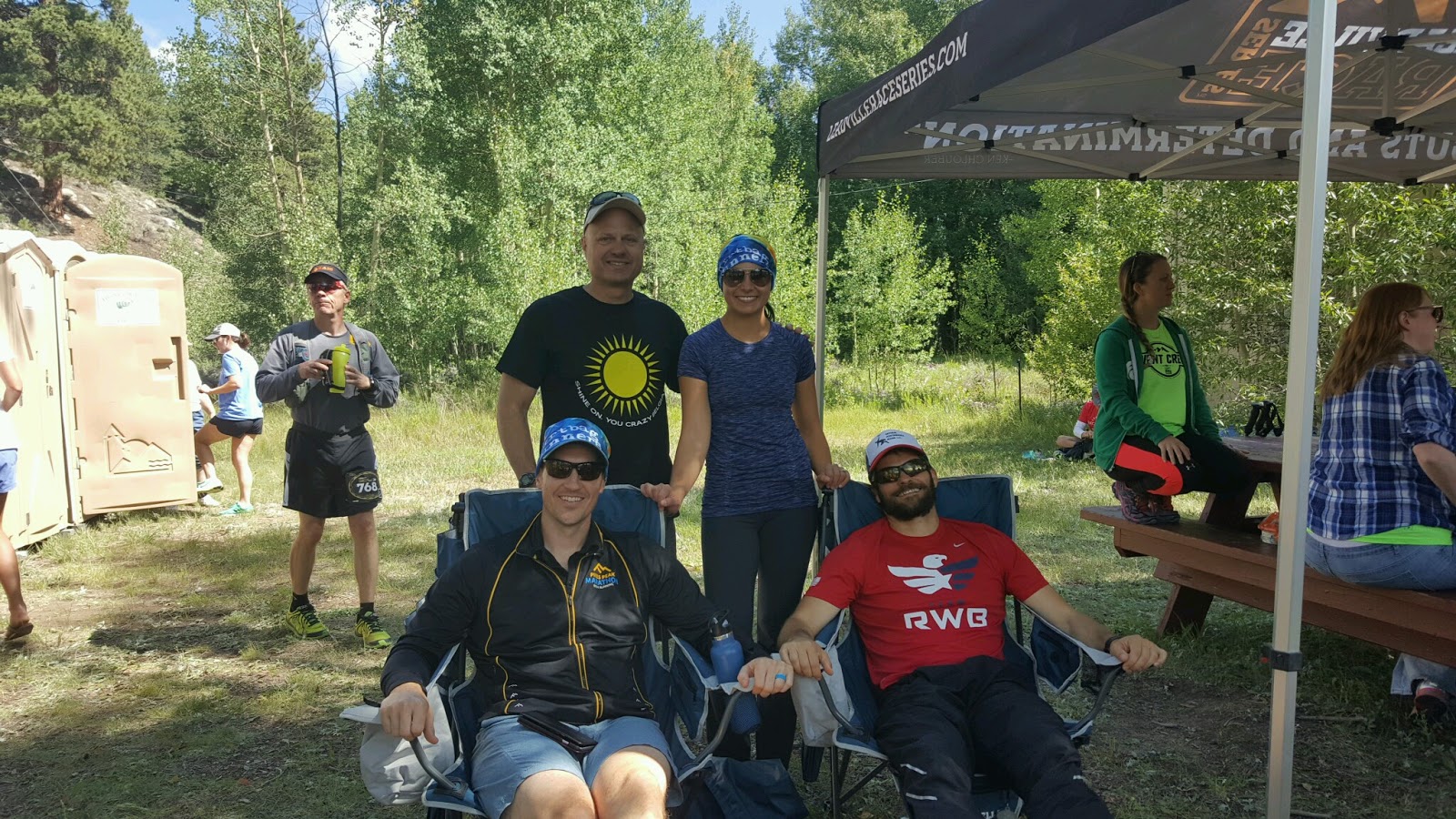 |
| The crew waiting at Twin lakes. |
 |
| Heading out of Twin Lakes (mile 39). |
I’m not sure how long I spent at Twin Lakes, but it was my
goal for the entire race to minimize time spent not moving forward. As soon as I felt ready, I grabbed my hiking
poles to conquer Hope Pass. As with any mountain pass, the weather can
degrade no matter how sunny the forecast may seem. To my excitement there was hardly a cloud
nearby but I carried a jacket, hat, and gloves just in case. Upon leaving Twin Lakes, the lowest point in
elevation on the course, we traverse a flood plain before reaching a river
crossing. The views of the towering
peaks are breath-taking and I didn't mind slowing down to enjoy it. I crossed the river and enjoyed the soothing cold hug it gave my feet and legs. I laughed when I saw
the sign after the river, “Do you like mountains because
hooo-boy have we got one for you.” They sure did.
 |
| Right after the river crossing. |
I hiked Hope Pass twice in training over the summer. During one of my trips I ran from Twin Lakes
to Winfield and back. While in Winfield
during that training run I had said to my friend Tim, “how do people ever leave this place?” My furthest run prior to Leadville had been 50 miles. Was I really going to go 50 miles, turn around and look at the mountain and say, "oh yeah, let's do this." But that's the funny thing about 100 miles that you don't understand until you actually do it. 42 miles into the race and I had no doubt I would have no problem turning around at Winfield and coming back over the pass.
Sometimes the
anticipation is worse than actually doing the thing you’re anticipating.
There are llamas and people who hike up near the top of
Hope Pass to set up an aid station. It
is well-placed as many runners can be short on water and supplies due to the
amount of time it takes to hike the pass.
I grabbed a few slices of watermelon and continued the final push to the
top. I reached the summit alongside Sami
Inkenin and began thinking how people just seemed to pop up out of nowhere at Leadville. I hadn’t seen Sami since climbing Powerline. He looked like he was doing alright to me and yet I realized I had just hiked up the mountain more quickly. I knew the backside of Hope Pass would be Mc-sketchy footing so I motioned to Sami to start the descent first. To my surprise he waved me in front.
 |
| Coming down Hope Pass towards Winfield. |
There's a trick I use all the time during training and
competition. The premise is this, anything you do to relax
your mind and body will improve your performance. There is power in learning to relax in
situations that normally increase your stress response. I did my best to enjoy the views and
appreciate the moment as I slid down gravel sections and my feet twisted
about. At some point on the way to
Winfield I twisted and pinched my right ankle joint. Over the course of a few miles it began to
ache ever so slightly but I made it to Winfield without having to slow down.
 |
| Hiking into Winfield with Kelly (left) and Jenn (right). |
When the trail dumped me on the road to Winfield at 3pm two
of my friends were there to meet me at the road. I enjoy running alone but a 50-mile
day is an awful lot of Sam-alone time. The
rest of my crew waited at the aid station another half-mile down the road. I tried to make my Winfield stop as short as possible
but this one would take longer so my friend Joe (a physical therapist as well) could assess and
treat my foot. I grabbed two cups of
ramen and a heap of water melon slices, then sat down so Joe could unstiffen my
ankle and foot. I knew that with running
and hiking the foot would re-stiffen and the pain would build up until it hit
an undetermined maximum. Whatever that
pain was going to be I would just have to deal with it for the next 50 miles. Joe would be pacing a mutual friend and not at
aid stations to help me.
 |
| Running into the Winfield aid station. |
 |
| Multi-tasking with ramen and physical therapy. |
The real race
was about to start. If I wanted to earn
a gold or silver buckle, as Ken says, I would need to do what the miners did. It was time to dig deep.
My first pacer, Melissa, had also been in charge of all of
my crew’s logistics. I knew she had to
be tired since her 2:30am wake-up call but she seemed to hide it well. Despite the known challenges ahead, I left
Winfield in good spirits having now a buddy to help me along the way.
 |
| Leaving Winfield with a pacer, huge accomplishment! |
Melissa did her best to get me to eat solid food before we arrived at the Hope Pass ascent. As we began to climb I noticed my foot felt less stressed hiking uphill. It was the running, especially downhill, that worsened the pain
quickly. Realizing this, I did a quick mental
scan of the return trip and the bigger climbs that would ensue. I felt I could stay on pace
during all of the big climbs but I would lose a lot of time on the flat and downhill sections depending on how much running I could tolerate. I wasn’t particularly happy with this fact,
but I had such an advance on the cutoffs I felt I could hike the
second-half of the race and finish before the 30-hr time limit. I would just have to be extra careful to keep
moving and not waste any time.
I might be slow but
I didn't have to converse with self-pity.
I used a walk-jog approach back into Twin
Lakes which seemed to minimized the pain as long as I was careful about foot
placement. My crew was back at Twin Lakes to greet me
with big smiles. I did my best to be
positive and appreciative despite the increasing fear of debilitating
pain. It was still manageable but for how long?
 |
| Running into Twin Lakes around mile 60. |
 |
| Changing sandals again and trying to massage my stiff foot. |
Melissa would be pacing me all the way to the Outward bound
aid station, around mile 76. It was her
personal goal to keep me eating enough so I didn’t completely crash. While I mashed salty, boiled potatoes around in my mouth I made another assessment. If I had to walk most of the
way back I would be in fat-burning mode, nowhere close to red-line, so I shouldn't really require that much food to finish. This was good news in the midst of the foot issue. I wanted to finish but I didn't want to be a surgical
consultation on Monday. After a short bit of rest
and time for Melissa to refuel, we set back to the trail at a good
hiking pace.
 |
| Leaving Twin Lakes for the second time. |
We were now climbing two steep miles back to the Mount Elbert water-only station. As we ascended in elevation we watched the
sun set over the vast expanse of the lakes and the nearby mountain peaks. It was a moment of pure gratitude and joy.
 |
| It's kind of like this. |
Evening seemed to come quickly and we pulled out the
headlamps somewhere near the top of the climb.
On the Colorado Trail section we encountered a hiker right at dusk. When he saw us he asked, “hey, do you guys
know of any good camping sites around here?”
I laughed a little, “I don’t know
because I’m not familiar with the area.
Sorry we are in a race.”
Melissa looked over, directly at a campsite the gentleman was standing
next to and said, “that one looks good.” As we moved on we could hear him say, “yeah this one looks okay.” We both laughed at the idea of giving
campsite advice during the Leadville 100.
Once off the Colorado trail we hit a rocky dirt road leading to the
Halfpipe aid station. By this time it
was very dark and I could feel a sharp pain in my foot with every step I
took. We stopped a couple times so
Melissa could help me stretch and try to take pressure off. Unfortunately it didn’t work at all.
I may have been an
athlete those first 50 miles but now I was more like a pirate, grunting and
fervently speed-limping down the trail.
Ken was so right, this was going to hurt.
The race was beginning to be a time warp. I knew this was a common symptom of Leadville
so I tried to stay relaxed and laugh about it.
About every 10-minutes I would say to Melissa, “I don’t remember this section being so long (or rocky, or steep, etc).” It felt like forever before Melissa and I
finally made it to the Halfpipe aid station.
From here I would have about 50k to go.
What’s a 50k? I have done lots of
those! This time I sat down for a moment
and tried to keep some delusional morale going as I rubbed my foot and Melissa refilled
my pack. Another friend in the race I have yet to introduce, Maggie, had been running behind up until this point. She saw I was having a foot issue and offered a pain patch from one of her aid bags.
I didn't realize it at the time but the
patch wasn’t anti-inflammatory.
I must have heard her wrong. I took the patch because I felt my pain was coming from tendons, surely 31 miles of an anti-inflammatory patch wouldn't lead me to see the surgeon. I needed my body to tell me when to stop but this pain wasn't enough to stop me, it was just disheartening. I thanked Maggie, placed the patch right over my swollen tendons, and started on my way again.
At first I felt
nothing but after 5 minutes or so of pirate-hiking, I began to feel the burning
sensation.
Melissa corrected me, it was a hot patch, like the kind people put on their backs. Huh? I now had burning sensation to go with my sharp pain on every step. It got me thinking, the more
I tried to fix this foot issue, the worse it got. Was there a lesson somewhere? I tried to think and talk about other
things with Melissa to change my focus.
Despite the pain, it was actually a beautiful night with a thick blanket of stars.
At the
gravel pit I sat down for a second to see if Kelly would be able unlock the stiff joints in my foot. Unfortunately as she worked I could feel another concerning sensation that wasn't painful. It was cold. I had already lost a great deal of heat in the span of two minutes or so. I knew it was dehydration and yet there was little I could do to improve my fluid intake. New rule, avoid stopping if I wanted to finish Leadville.
 |
| Crew hanging at the gravel pit waiting for Melissa and I. |
 |
| The gravel pit inbound. I was tired for sure. |
The next aid station, Outward Bound, wasn't much further and Melissa and I would be able to get on pavement for awhile. Normally I don't enjoy running pavement but in this case it was less taxing on my foot. When we hit the road Melissa convinced me to shuffle (she called it running). I looked at the GPS watch on my wrist. “Hey
Melissa, if you’ve ever wondered what a 12-min mile feels like, this is it!”
We laughed and both knew that my 12-min
pace was huge compared to the last 5 miles of speed
hiking. We crossed the field to the
Outward bound aid station and Melissa ran slightly ahead to alert my crew and
ensure my next pacer, Chad, was ready to roll.
As I hobbled for a moment alone in the field with the stars
twinkling quietly above, I found myself recommitting for the hundredth time to finishing this race. I knew the pain would only get worse. My
digestion and body temperature regulation were abysmal. The challenges of Leadville would
be just like those in life. They were inevitable
and yet unpredictable; you didn’t know when or what form they would take.
I began to recognize that I’d had two voices
in my head the entire time. One voice
was giving practical updates of the situation while the second voice did not
care so much. The second voice only said
I could do it. In the same way a tree
grows up and my eyes are colored blue, it was as though the story had already
been written, it was a law of nature.
Somehow I knew I was going to make it.
Coming into the Outward bound aid station I was sure that I
was done eating. I could wave goodbye to
digestive homeostasis as anything I ingested, except water, was quickly finding
its way out of my body. Fortunately I
had run many miles fasted over the summer so I had a sense that I would
definitely have the energy to power hike to the finish.
It was cold at this point and time to start layering up. I remember Melissa saying, “you probably want to change to a dry shirt
before you layer” as would be customary to do in the mountains. However
when I grabbed my shirt near the chest and back, where I would
normally sweat, and it felt completely dry.
I knew I was dehydrated but this was ridiculous. I don't never not stop sweating! I dutifully added layers and told Chad I would start walking and he could catch up. I took a cup of ramen with me in hopes that I
could eat some warm calories as I walked the pavement towards the Fish
Hatchery. We had a few relatively easy
miles before starting the Powerline climb.
Chad of course had no issues catching up to me down the
road. He offered to take my pack and I
obliged. Clearly I wasn’t going to come
out a hero in this race. “What does this pack weight, 20lbs?!”
Chad joked when he took my reservoir.
“Yeah I guess it is heavy but that
hasn’t really bothered me.” I handed
Chad my half-eaten ramen cup after a short time. “I
can’t eat this. I want to but I can’t.” As we reached the base of Powerline Chad stopped
for a moment to adjust the two packs he was now carrying while I hiked ahead. We ascended Powerline at a
reasonable pace and without too much complaining from my end. Chad did his part to distract me with a
series of stories about his kids and work, all of which should be written in his memoir. I listened like he was a book on audio.
It became ever more clear as the race progressed that my singular focus was to keep moving and
minimize downtime. This goal became so intense and ridiculous that each
time I wanted water from my reservoir, instead of stopping and leaning over to
drink from the tube on Chad’s back, I made him walk slowly beside me taking
tiny steps so I could drink and keep moving. I thought to myself this might also help me maintain warmth to a
degree. Stopping, even for a few
seconds, would throw me into shivering.
Chad had to invent a new kind of
gymnastics just to hold and rotate my gear as I asked for things. One minute he was tying off a jacket and
finding a place to store gloves and the next moment he was helping me put on
another shirt. I was glad Chad had three
young children; he was an expert at taking care of helpless individuals.
I didn’t believe Chad when he said we had reached the summit
of Powerline. I had barely noticed that
we had come upon the unofficial aid station, the “Space Station.” Powerline has multiple false summits but this
was a clear delineation we'd reached the top of Sugarloaf Pass. I suspect most runners rejoiced at this stage of the race but I couldn't knowing what would soon happen to my foot.
We descended powerline to
Hagerman Pass Road at a limping pace
as I like to call it. I tried to soak up some easier walking on Hagerman. When we hit the single-track that dropped us into May Queen, we had to navigate seriously technical terrain. I found my
repertoire of conversation quickly diminished to, “I
don’t remember this being so long,” “ahhhh!,”
and “we should be crossing a creek soon,
where the $@*# is that bridge?” We eventually crossed a bridge and I was devastated to
realize this wasn’t the bridge at the end of the trail. “I
don’t remember this bridge, I just remember one bridge.” I knew the pain, fatigue, and dehydration
were affecting what was left of my judgment and memory. Eventually we found the end of the trail and headed into the aid station. Chad started looking for Melissa.
Meanwhile I limped to the medical tent to see if I
could get help stabilizing my ankle. “Do you guys tape ankles or have anything for
compression?” There was a lone guy
at the medical tent who looked eager to help.
I was excited until he opened his mouth.
“No, we don’t really do that
here.” My eyes fell on a clear
plastic container sitting on a table. It was full of various kinds of tape to
include basic athletic tape. Clearly his
message was, I don’t know how to do that.
As I contemplated this situation the medic walked over with
Coban and offered to wrap my foot. I
didn’t have the heart to tell him that it wasn’t going to do anything so I let him have at it. I would at least enjoy a moment off my feet. Chad stood and watched the medic attempting
to keep a straight face. I tried to recalculate the remainder of the race. I was still ahead on time and the worse was over. When the medic had finished his loose-wrap, I thanked him for his help, fastened my sandal, and hurried back onto the course. Chad stopped at a campground restroom briefly
and when he came out he realized I was walking down the wrong road. Before he said a thing I turned around, “I think I’m going the wrong way.” Luckily it was a 150-meter mistake.
 |
| May Queen aid station in bound. |
Minutes later…“I don’t
remember this being so rocky and technical,” I said to Chad as we headed
toward Tabor Boat Ramp. I think I was
still trying to jog a few steps at a time but the uneven terrain made it
unbearable. It was along this section
that my GPS watch died again. “I thought Scott said this thing can last
24-hrs!” I felt annoyed for a brief
second but quickly realized it didn’t matter, I just needed to know the time. Shortly thereafter we ran into a pacer who
was alone and running in the opposite direction. I was excited to see her since I knew once we made Tabor Boat Ramp the trail would be less technical. I asked the pacer how far we
were from the boat ramp. As she ran by me I heard, “Uh…uh….uh, I’m not sure of the time or distance I’ve gone.” Chad and I both felt that was peculiar because
we were pretty darn sure we were getting close. Fortunately a few minutes later we spotted lights from the ramp.
Melissa arrived to May Queen a couple minutes after we’d had
left. By now she was waiting at Tabor
for us to check in. This would be the final crew area until we finished. As Chad and I were nearing, Melissa could hear me burp loudly. She casually stated aloud, “Oh, that’s Sam!” A man
standing near her said, “there’s no way
you can know your runner’s burp. It’s
like how people say they know their dog’s bark, they think they know their
dog’s bark but they don’t.” Melissa
assured the man that she knew exactly how my burps sound having listened to them for hours on end. A
moment later Chad and I emerged from the woods and onto the ramp. “See I
told you!” Chad stopped for a moment
to unload his stuff so he could just carry my things and a water bottle for
himself. I continued hiking along the
lake, my thoughts bouncing between the absurdity of the Coban around my ankle and the mini-Powerline
section that still awaited us.
It was beginning to get light and fog was building as Chad and I made our way to CR 4. It was
significantly warmer than I’d expected but I knew as the sun rose it might get
colder. Thankfully Chad was still
packing a significant heap of my clothes.
Reaching the road again was a huge success for me; from here I only had to tackle
a rocky section of trail lovingly known as mini-Powerline.
“This
is like the final nail in the coffin. After
all this, seriously Leadville the big Powerline wasn't enough?” Understandably some of my zen had faded after 95 miles. This is when the internet memes start popping in your head, namaste positive Sam, namaste positive. I moved slowly down the trail, one step at a time, and though it was painful I made it safely. The worst was over, again.
It was slow hiking the final five miles of the race. Along the way we met Megan Finnesy, the race
director of the Dirty 30. Chad and I
said hello and commended her on the awesomeness that is the Dirty 30 race. She invited us to her new race, the Silverton
Double Dirty 30. In that moment I wasn't putting my 2017 race calendar together but God bless her. We also conversed with
a pacer who was encouraging anyone within earshot to love their family and
friends and not worry about politics. He
was carrying an American flag.
At some point we found ourselves gaining elevation on a long
gravel road. We hit one false summit
after another. I didn’t know the mileage
any more, only that since we’d left the lake, I knew we were always less than 5 miles. “How
long is this road?” I asked Chad for the 17th time. As the sun rose higher, a breeze
developed, and the temperature dropped slightly. Chad helped me with a jacket. Three minutes later he helped me take it off.
When I saw the end of the gravel road ahead, I finally
gained my bearings. The finish line was
close. Most of my crew had been waiting
for me at the top of the gravel road and cheered as I approached. Together we topped the final hill to the
finish line. Now I could see with my
eyes what I had envisioned for months. I
summoned what was left of my endogenous pain-mediators and we ran through the
finish line together. I ran straight to Merilee
and was given a huge hug, a medal, and a rose.
Ken was there to congratulate me as well. Tears formed in my eyes as the last 28-plus
hours flashed before my eyes. I was so
dehydrated I didn’t think I could make tears.
The Leadville 100 trail run means many things to many
people. For me it was a celebration of
life and of all those who love me and came to support me. It was also a celebration of what the human body and spirit can do. I had gone from chronically-injured runner to completing 100-miles in nothing more than basic sandals in less than 2 years. I thought
back to every time I said “I don’t
remember this trail being so long!” I’ve thought many times in my life that it is not the challenge that we meet but how we
meet the challenge that matters. Leadville gave me the opportunity to meet the challenge and I did.
I knew as long as I could live this, I'd have everything I always wanted and needed.
 |
| Hiking the final section with my friends, crew, and pacer Chad. |
 |
| Running into the finish line surrounded by friends (and our buddy with the American Flag). |
 |
| Couldn't have done it without my crew and pacers. (pictured: Melissa, myself, Chad) |


